Showing posts with label Saharawi short stories. Show all posts

Monday, 16 July 2012

Mine victims, by Nick Jubber


In a flaky pink apartment block in the Nahader district, a girl with henna on her hands pulled back the metal door and ushered me up the stairs. In a large room fringed with cushions, I sat on the woollen rug of a guest room while Mohammed Ali, director of the local mine victims’ association, prepared tea on a coal stove. I had come to listen to Ahmed, a student in his early twenties who was involved in a landmine accident a couple of years ago.
  ‘I was visiting my friend in an area south-east of Laayoune, about three hundred kilometres south,’ said Ahmed. He was an angular young man in his early twenties, his square-cut face softened by his glasses. ‘I was in the Land Rover with my friend’s father, Mohammed Nadher. He kept camels and around three hundred goats and we were driving between his tent and the field where he kept his goats when the back wheels went over an anti-charge. I remember running – about fifty metres away – I just ran – it was only when I was away from the explosion that I understood what had happened. My friend’s father was lying on the ground near the car. I pulled him away but the explosion had torn his feet open so he couldn’t walk. His sons heard the explosion and they came to find us, followed by the police who took us to Mohammed’s tent.’
  An ambulance came, much later, carrying Ahmed and Mohammed to the military hospital in Laayoune.
  ‘But,’ he explained, ‘they only looked at our injuries. I was burned all the way up my leg. They refused to do anything for us, so we were taken to another hospital, and by this time it was too late to save Mohammed’s foot so his toe had to be amputated.’
  It was only after several months of recovery that Mohammed went back to his flock; but now, unsteady on his feet, he was unable to herd them as well as in the past, so he sold up and moved to Laayoune.
  ‘What about you?’ I asked. ‘Did you have any after-effects?’
  ‘I hear a buzzing in my ears sometimes,’ he said, ‘but I am strong, I’m not afraid.’
  For Mohammed Ali, it was clear who was to blame.
  ‘The Moroccan government,’ he said, ‘doesn’t even publicise the mine situation – there are no posters about it, they never mention it on TV or radio, so people aren’t educated about it. Especially people who live in the desert – they need to know about the mines but many of them don’t even know what a mine looks like.’
Saharawi landmine victim (in the camps).
Photo by Bernat Millet
  Mohammed and Ahmed talked angrily of the Moroccan government’s failure to sign the Ottawa accord guaranteeing reparations to victims, or to make substantial efforts to map the mined areas.
  ‘It’s not only Morocco who planted the mines,’ said Mohammed, ‘Mauretania, Spain and the Polisario have all been responsible, but it is Morocco that has the authority here and they do nothing to help us. We’re Saharawi – we love the desert, it’s part of us. I like to spend my time in the city but also in the desert. But we have to be so careful when we go into the desert because of the mines.’
  ‘Without the desert,’ said Ahmed, ‘we are like fish out of water. But how can we use the desert when we are afraid we may step on a mine?’

Tuesday, 10 July 2012

Exodus, by Nick Jubber


If there was one subject all the Saharawis I met in Laayoune wanted to talk about, it was Gudaym Izik (Gdeim Izik) – the protest camp set up in November 2010.
  ‘I was in the first group,’ explained Ali Salem, a veteran activist in his forties. ‘We went to an area called Gudaym Izik (Gdeim Izik), twelve kilometres to the east of the city, and set up a camp. At first there were thirty-five tents, but over the days it grew. People came out from Laayoune to join us and we had 20,000 by the peak in 6,600 tents. We called it our ‘Exodus’ camp, it was a protest against the social marginalisation and the lack of decent jobs, decent housing, legal rights. But it became something more than that – people came to the camp to go back to their roots, back to what being a Saharawi is about. We wanted to show the world we can live on our own, we can live away from civilisation, we belong to the desert.
Gdeim Izik protest camp on Nov 5, 2010.
Photo by Tenerife con el Sáhara
  ‘Many young people joined the camps – people who had been irresponsible in the town, they just hung about doing nothing with their lives, but in the camp they were transformed. They set up committees for nutrition, hygiene, security, administration. They helped organise the food. Going back to their roots brought something out of them. There was no crime, no complaining. People lived in the tents together. As long as you were Saharawi you didn’t care if you weren’t related.’


  ‘It was like a utopia,’ said his friend Mohammed. ‘Rich and poor joined in, people from different cities, young and old.’
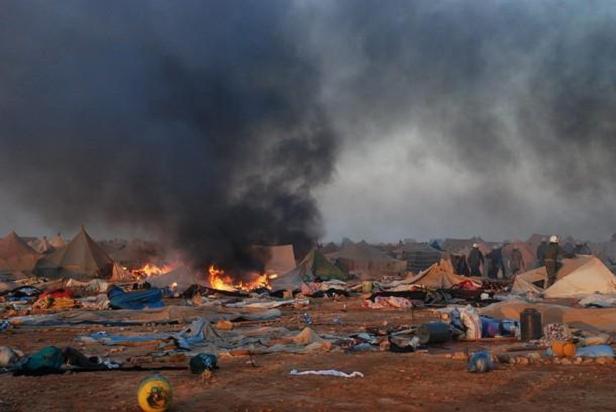
  ‘They tried to do the same in other cities,’ said Ali, ‘in Dakhla, Smara, Goulmime, but the police arrested them, harassed them, took them to prison. But Moroccans who were living here, and also some Saharawi bloodsuckers who’ve benefitted from the system, were anxious. They saw a young generation who wouldn’t let them carry on benefitting from our resources. So one morning at 5 am the people in the camp were woken by the sound of helicopters and voices telling them in Hassaniya: ‘You can go home now, your complaints are being answered.’ Then the forces moved in, they burned the tents and destroyed equipment, people started panicking. They chased people, beat them up, especially the young ones. Or they told them, ‘come in the van, we’ll take you back to Laayoune’ – and instead they took them to prison.’
Destruction of the protest camp by Moroccan authorities
on Nov 17, 2010. Photo by Ceasefire Magazine

Monday, 18 June 2012

Sahara Nights review

The Roundhouse Studio-Theatre was filled to the brim last week for Sahara Nights on June 6. The multi-arts launch for the Studio-Live music empowerment project brought the house down with an array of film, photography, short story presentations and wonderful music to provide rich glimpses of the Saharawi world, culture and plight. 

Nigerian playwright and poet Inua Ellams,
Saharawi short stories readings, with Celtic violinist Lizzie Ogle and
Guinean kora player Mosi Conde © See Li

The launch was interlaced with fantastic first-class performances from a wide range of international artists...

Guinean kora player Mosi Conde
with photography by Ed Harriman © Tania Jackson

British-Congolese Binisa Bonner
from Ruby and the Vines © See Li
Venezuelan Luzmira Zerpa
from Family Atlantica © See Li

Hispano-Saharawi
singer and guitarist
Suilma Aali and percussionist
Nico Roca © Bela Molnar

The evening culminated with a stellar performance from Aziza Brahim. Born in the refugee camps, educated in Cuba and now based in Spain, Aziza is considered the new musical voice of the Saharawis, dedicating all her songs to the struggle. Her music is inspired by her poetess grandmother Mabruk, the only Saharawi female poet who has dedicated all her poetry to documenting the 16 years of war and to whom Aziza has dedicated her new album (released June 11).

Aziza with Spanish guitarist
Gonzalo Ordás © Bela Molnar


Aziza and Gonazalo © See Li
Aziza Brahim © Julia Ridlington


Sahara Nights was capped with the mother of all jam sessions. Virtually all the musicians of the evening joined along with a few new guests from Algeria to rocket the night into another music stratosphere that got the room dancing with abandon.


Final jam session © Julia Ridlington

What people have said:

It was a rich and diverse gathering with original and soulful music and poetry (hearing Aziza live and discovering her grandmother was incredibly emotional). Your passion and dedication for the Saharawi cause and its people was truly palpable. Meriem Aissaoui


Aziza and the Sahara Nights crowd © See Li
A fantastic evening and very informative in a sensitive way. Thomas Elliot

What an amazing evening. Congratulations on such a success, and thanks so much for letting me show part of our film. You know how important your support was to us when we started filming so I'm forever indebted to you. Saeed Taji Farouky

Friday, 1 June 2012

Inua Ellams


More wonderful artists performing at Sahara Nights!


Born in Jos, Plateau State, Nigeria ‘1984, Inua Ellams is a Word and Graphic Artist, a writer with a style as influenced by Classic literature as it is by hip hop, by Keats as it is by MosDef. Rooted in a love for rhythm and language, he crosses 18th century romanticism & traditional story telling with contemporary diction, loose rhythm and rhyme. However, his first love was visual art; the first time he toyed with a pencil, he fell for the magic of line and form. He works extensively as a graphic designer / visual artist and also tries to mix the old with the new juxtaposing texture and pigment with flat shades of color and digitally created designs. He works in online and print. (Info from MySpace)

Inua will be reading amazing stories by Saharawi ex-political prisoner Mustafa Abdel Dayem.


More info about Inua:
Phaze 05: www.phaze05.com
Inua Ellams: inuaellams.com
Twitter: @InuaEllams